Sunday, 22 January 2012

why

I've decided not to title the piece until it's completion, and for the same reason won't be submitting an artists statement for assessment. I could do both at this stage, and feel that neither would alter greatly in the time it will take to compete the piece, however it doesn't feel appropriate to do so. Until it is finished there is always room for the piece to evolve, and along with it the title and supporting information.


I do, however, have confidence in this piece of work despite its slow progress. Had I been actioning this piece outside of the academic environment I wouldn't have worked to such a tight deadline, and would've instead set a more realistic target of approximately six months, as opposed to four. Production of this piece will continue alongside my next negotiated module.

Saturday, 21 January 2012

how

http://www.channel4.com/programmes/britains-trillion-pound-horror-story/


Britain's Trillion Pound Horror Story aired in November 2010 in Up to Our Eyeballs on Channel 4. In order to allow the viewer to visualise the £4.8trillion of national debt the film maker Martin Durkin used an animated clip showing a stack of £50 notes leaving the earth's atmosphere and reaching 6,561miles high. Considering a £50 note is equivalent to 0.11mm and a 1mm stack is equal to just under £500, it really emphasises the actuality of such a vast amount.  


Providing the actuality of information storage on redundant technology in relation to modern day devices, draws an interesting parallel. Representing a 2GB laptop is nothing when contemplating a 16GB USB stick. Everything is smaller, quicker, better, but reliability can always come into question.

Friday, 20 January 2012

what


In order to pack out the installation to demonstrate 1422.22 floppy disks I am using redwood posts, cut down from 4x4 to 94mm x 84mm (floppy dimensions). The posts, currently 1m lengths, will need to be cut down to 8 x 810mm and 1 x 734.4mm lengths in order to, as exactly as possible, represent the desired number of disks.

Friday, 13 January 2012

how

More math...


142.3 x 54mm = 7,684.2


7,684.2 / 1423 = 5.4mm


5.4mm x 160 = 864mm


5.4mm x 143 = 772.2mm


87 disks: 8 x 10 & 1 x 7


864mm - 54mm [10 disks] = 810mm


772.2mm - 37.8mm [7 disks] = 734.4mm

Wednesday, 11 January 2012

how

The disks, I feel, need to be stacked one on top of the other in a sculptural arrangement. The principal aspect of the piece is the mass of disks, and this is best represented as a bulk, as opposed to a spread. I want them to be stacked freestanding on the floor in a way that in no way represents a familiar arrangement of floppy disks, yet is indicative of the sheer volume of them. 


I'd like for the viewer to be able to see the top disk on any one stack, so that the object is openly accessible from as many viewpoints as possible.


Bearing this in mind, and taking into account that I currently have 88 disks to display, I have come to the following calculation: 


1423 [1422.22] / 9 = 158.11
160 x 8 = 1280
1423 - 1280 = 143


8 stacks of 160 disks
1 stack of 143 disks

Arranged foursquare in a 9 square grid:


how

I am up to 88 floppy disks, all of which fired. The delivery of the piece now needs to take precedence over continued production.


The floppy's need to be separated with some sort of spacer as some are slightly bowed/not exact. 


Stacked using clear silicone drawer and door closures (with self adhesive), 10 floppy's = 79mm. 1423 (0.22 to be counted as 1) stacked using clear silicone closures = approx 11,242cm (11.25m). 


Stacked using adhesive backed magnetic disks (with self adhesive), 10 floppy's = 63mm. 1423 stacked using magnetic disks = approx 8,949cm (9m).


Stacked using 13mm did x 3mm thick round felt pads (with self adhesive), 10 floppy's = 54mm. 1423 stacked using felt pads = approx 7,684cm (7.68m).


Stacked using capacity clear 3.5" disk cases/mailers, 10 floppy's = 85mm. 1423 stacked using disk cases = approx 12,095cm (12.1m).


I tried using 3/4 inch plastic washers, thinking that a larger surface area [spacer] would allow for improved balance, but there wasn't enough give to allow for the inconsistencies between the disks. I also think I'm going to need to use a spacer that has an adhesive, for stability. 

Tuesday, 10 January 2012

how


As I'm fast approaching the assessment deadline and producing the required amount of floppy disks is unachievable to say the least, my attention is now focused on how to give a projected vision of the project outcome. 

Using the dimensions above and calculating the height in relation to spacers/stacking, I'd like to somehow pack the installation whilst still only occupying approximately the same amount of space as would 1422.22 ceramic floppy disks. Using 4x4 timber posts, cut down to size, is the best way that I can think of to do so:

why

There has been a constant struggle to articulate this particular project, and today's tutorial proved no different. However, quite conversely, my faith in the idea (however loose and indistinct it can and has appeared) is gaining momentum. I know that there is an interesting piece at the end of this module of work. It may not present itself in time for the assessment, and it may not sit comfortably in and around the assessment criteria, however I feel that my creative development is of more importance than academic achievement at this moment in time. It's why I'm continuing to work in an obsessive and systematic fashion without deviation and compromise.


I am up to 63 disks, all fired, and am continuing to cast. 1359.22 remaining.

Tuesday, 3 January 2012

why


So far I have 32 floppy disks, 27 of which are still to be fired. 1390.22 remaining.


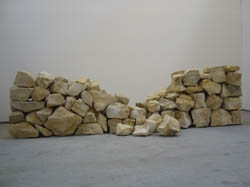
There is something really inviting about the monotony of producing these objects by hand, especially as I have a target in view [1422.22]. It matters little that I have a deadline looming, one that makes reaching that target entirely impossible. The element of endurance and nebulous repetition seems to be propelling me to continue. It is for me reminiscent of a piece of work I saw at the Saatchi Gallery in 2010: Wall by Rupert Norfolk, similarly involves a serious investment of time into what appears to be an obscure undertaking.


Wall (2006)
125 carved limestone rocks

The limestone rocks were hand carved by Norfolk in order that they become symmetrical objects, with one half of each of the 125 rocks chiselled so as to mirror the natural hollows and protrusions of the opposite side.

It has become quite a feature of my work of late to invest heavily in process and time, which in itself draws from the very nature of obsolescence and its origins in the need for improved efficiency and performance from our tools.

The hard drive that recently failed (it's happened more than once!) resulted in me losing data, time, money, patience, sanity (almost), and this has become pertinent to my casts. To an extent what I am doing by systematically creating casts of floppy disks is mirroring this loss, and giving it a material presence.

Tuesday, 6 December 2011

why

My initial concept didn't have the strength to stand alone and is both airy, in its lack of concrete definition; and muddied by the marrying of concept to process. It's not enough to index, via the process of casting, the absence of the objects that I've selected, and in order to dissolve the boundaries between the past and the present I need the casts to do more than just exist as dumb objects.


A suggestion was raised in a group crit today, in relation to the concept of information storage, that I should explore a comparison between the capacity storage of a floppy disk with that of modern day hard drives, external or otherwise. The common format 3 1/2 inch floppy disk has a capacity storage of 1.44MB. Working on the formula that 1GB is equivalent to 1024MB a 16GB USB flash drive is therefore equivalent to 11,377.78 floppy disks; with a 500GB external hard drive equivalent to 355,555,56 floppy's. 


I recently moved from PC to Mac after the hard drive failed on my DELL Inspiron 1545 2GB PC (equivalent to 1422.22 floppy disks). Following on from the crit today I'm now really enthused about the idea of incorporating this hard drive failure into my work. I've had a series of low end PC lap tops that have lasted at the most 2-3years before experiencing faults on the hard drives. Floppy's may well have outlived their usage but they were nothing if not reliable.

Monday, 5 December 2011

how not to


Vaseline oil isn't an effective release agent.

Casting in materials other than porcelain (crystal resin as above, and cold casting using brass/bronze/aluminium powder) is something that I anticipate exploring further on completion of this module.

Monday, 28 November 2011

why

Ron Arad
Concrete Stereo (1983)
record player, amplifier, two speakers, electronic components: incorporated into concrete


Su-Mei Tse
Stille Disco (2010)
installation of stone sculptures


Onkar Kular
Betacam Tape: The MacGuffin Library (2008)
black polymer resin

The broader my research is becoming, the more I want to cast in different materials. There are other avenues I could explore from my current position: the destruction/deformation of the original object; glazes and firing; the durability of the porcelain; digital production methods (CAD/CAM/CNC routers/laser and water-jet cutters???) etc: however it is the actual casting material that I want to plumb.

Resin seems like a natural choice as it'll result in a transparent solid that would provide considerable contrast to the ceramic objects. I'm really concerned though about the release agent as each each substance that I've researched (silicone/soap/beeswax/Vaseline oil/petroleum jelly/PVA/spray paint) seems to match success story for failure. It's important that the mold doesn't end up as a waste mold and is reusable, however as with any kind of casting it is essentially a game of chance.


Wednesday, 23 November 2011

what

http://news.bbc.co.uk/1/hi/magazine/8646699.stm - The mystery of the mega-selling floppy disk by Jason Palmer, BBC News, April 2010

"There are people who ride technology for as long as it can be ridden without falling over."

Are there really? I think that "old habits [do indeed] die hard" but surely our hands are forced when the technology of today shuns these 'habits' so entirely. Essentially there isn't anything that outperforms the floppy but still it finds itself supplanted. Why?

Monday, 14 November 2011

how


I've been thinking about delivery systems for a while now. It's a difficult thing to approach when the concept itself is still so ill-defined. There is, however, something quite charming about encasing the casts in the tape/disk carriers, as pictured above. They, rather conversely, become quite precious, due to their individual clear perspex display cabinets, and at the same time less precious as they move closer towards the object and further away from their fragile structural actuality. 

Friday, 11 November 2011

what

what


I can't seem to achieve the same level of exactness with the VHS/Betamax tapes as I have done with the cassette tapes, and this project doesn't afford me the time I think I'll need in order to do so. Because of this I've decided to focus my attention on the smaller devices (cassette tape/disks) for the time being.

Thursday, 10 November 2011

what

I'm relatively happy with the results of the cassette tape (what 26/10/11), however I am wanting to improve on the quality of the cast and move the reservoir to a less obvious position. They work really well as dumb objects, but they need more precision and exactness to avoid looking like naive casts. At the same time I'd like to (re)attempt to cast the above objects. I'm moving away from the devices used to read data, and focusing on the actual data storage discs/tapes. 

I have been really concerned that I'm trying to marry a concept and a process that don't sit well together, however I have this urge to make/cast, and I feel that there is something exciting in what I'm doing. Like Whiteread I think the idea of seriality and repetition could draw this out.

Wednesday, 9 November 2011

untitled

It's not possible to work in the manner in which I am and fail to register a connection with work by Rachel Whiteread. It comes up in tutorials and crits alike, and has resurfaced from time to time in my research. The most definitive parallel is that I cast directly from known and familiar objects.

Whiteread has demonstrated an almost unparalleled dedication to the process of casting, however avoids being typecast as a traditionalist by shifting from material to material (plaster/wax/resin/rubber/marble/aluminium) and working in seriality and repetition. Her work approaches the concept of dematerialisation by supplanting the object with it's opposite: the space around it.

Untitled: Twenty-Four switches (1998)
aluminium

I saw this piece recently at Tate Liverpool. I was really surprised at first thinking that the cast captured positive space as opposed to negative (which is very unlike Whitread), however on closer reflection the switches and the screws are inverted which gives rise to the fact that the face, at least, is a negative cast. The thing that really struck me however was the fact that the switches are randomly positioned, and in a solid aluminium cast of a piece of electrical equipment, this portrays a very human influence. In much the same way that Essen used his antiquated concrete radio to broadcast recent events (the rioting and looting across the country in August of this year) it moves past process and artist to suggest the relationship between us and the object.