
Thursday, 20 October 2011

Wednesday, 19 October 2011
how
 |
| fill holes |
 |
| build clay walls with keys for end part |
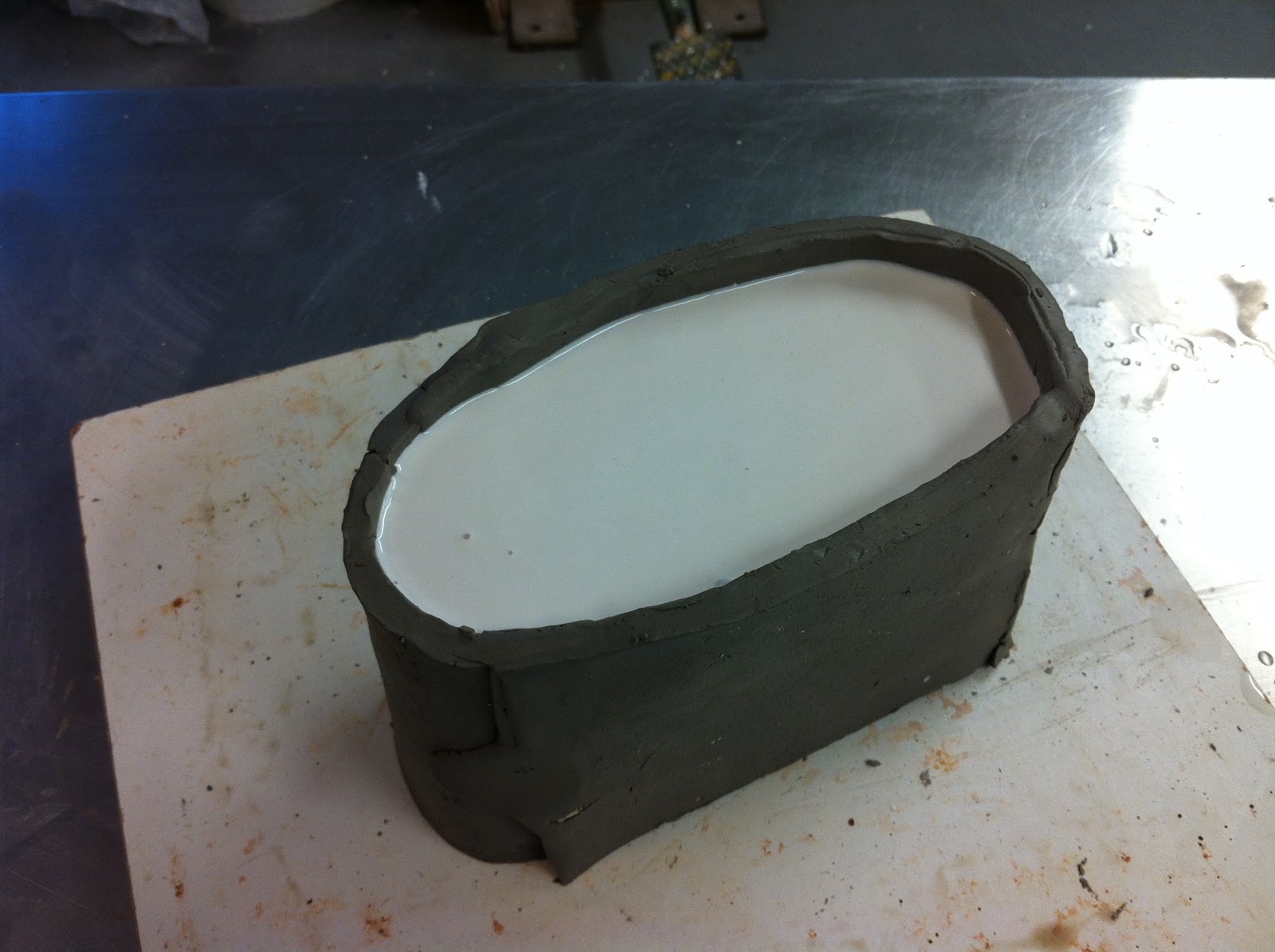 |
| fill with plaster |
 |
| build clay walls for side part with keys, fill with plaster - flip and repeat (adding clay reservoir on one side for slip) |
 |
| secure then pour in slip |
Monday, 17 October 2011
poison pen

Katherine Morling
Poison Pen (2010)
porcelain with black stain
Poison Pen forms only a small part of what is a much larger installation [Out of the House: as seen at Collect 2011, Saatchi Gallery] of monochromatic ceramic objects.
There is a whimsical theatricality to Morling's ceramics. They are at once nostalgic; familiar; fragile; and mundane, and succeed in becoming a vacant representation of their former selves.
Ceramics is a good imitator of other materials and is adept at taking on board a desired form, which makes it an obvious choice when wanting to replicate an object. It also offers a strong sense of history and tradition, something that, it stands to reason, is missing from modern day processes and materials. Slip-cast it can be solid or hollow which can also add to the solidity or fragility of the piece.
The idea of 'hinting at past times' is something that sits well with my narrative of obsolescence, and the reproduction of objects in ceramics that have simultaneously both a comfortable familiarity and an uneasy blankness is where my current thinking lies. It combines that which is present, through the form in which it takes, and that which is other, in the absence of the actual object.
Sunday, 16 October 2011
concrete radio

Mark Essen
Concrete Radio (2011)
concrete sculpture and HD video, colour, sound
'Using George Berkeley's metaphysical theory of subjective idealism as a starting point, Mark Essen has developed a film work that encompasses his sculpture Concrete Radio. Filmed around the Wysing arts centre, Cambridgeshire, Archangel George presents the traces of human disruption in an abandoned and deserted landscape. The film adheres to Berkeley's theory of metaphysical perceptions of the mind; that the existence of ideas depends solely on their being perceived, and following thus, that ideas exist solely because of the mind. Essen's film posits that to exist is to perceive, or be perceivable and that it is the human presence that informs us of an action or consequence. Essen's sculpture will accompany the film in which it features'
I came across this piece at an exhibition called Crash at VIVID, Birmingham. For me, paramount to the idea of metaphysics and the weight of human presence and perception, is the fact that the radio itself reads as an obsolete relic, with the concrete representative of uninhabited space and emptiness.
what


Sony VHS tape
TDK D90 cassette tape
Sony C7 betamax player
G.E. answering machine
Mr.Data MF-2HD floppy disks
betamax/VHS tapes
These are a few items that I'm looking at to cast. I think it's important that I avoid anything especially nostalgic/retro, as they're really difficult notions to pull off in an artistic context. As a starting point, and with respect to my current position (my contexual research and conceptual exploration is still in the very early stages) I need to begin to make items that fit the criteria of obsolesence/out-moded/out-dated in an attempt to get the idea off the ground.
why
Having been born [1983] just prior to what is (now) referred to as the Information Age, and at a time whereby sweeping changes brought about by digital computing and communications technology were beginning to alter the face of modern society, I am very much interested in the disparity between the tools available to me as I was growing up, and those of today.
The commercial use of computers and mobile phones experienced explosive growth in the early 80’s, and led to a seismic shift in the way that we live, communicate and play. I can recall listening to tape cassettes, watching films on VHS, playing video games on a monochromatic Game Boy and only having (limited!) access to a house phone, all of which have/has been replaced and/or displaced by more efficient counterparts.
I don’t have a distrust of technology, change or progression but I do have a concern that as we continue to develop new technology we will continue to oversubscribe to it, and that too much of what we are able to do without it will be consumed by it. For this reason I would like to produce a body of work that carries a social commentary on technological progression, the forces driving it (political/social/economical) and its impact upon societal values.
During Level 4 I cast a computer system out of plaster in an attempt to portray the transient nature of technology and also question the value of technology in relation to obsolescence and supersession. This is something that I wish to revisit with this body of work, however with greater conceptual depth and finesse.


Cast Production (2010)
plaster
This piece challenges the disengagement of traditional practice in the art culture of today, reflecting upon the effect that technology has had upon our sensibilities. In an age whereby cognition seems to frequently displace emotion, my intention is to call into question the validity of conventional processes, in direct comparison to technological progression, whilst maintaining a tangible association with the piece.
My intention now, almost two years on, is to move away from the notion of craft versus technology and concentrate solely on obsolescence. My decision to revisit the process of casting is an attempt to draw narrative from the fact that to cast is to index an absence; the object no longer exists and what is gained is residual and vestigial. It becomes both material and immaterial, present and absent: a vacant mass.
The commercial use of computers and mobile phones experienced explosive growth in the early 80’s, and led to a seismic shift in the way that we live, communicate and play. I can recall listening to tape cassettes, watching films on VHS, playing video games on a monochromatic Game Boy and only having (limited!) access to a house phone, all of which have/has been replaced and/or displaced by more efficient counterparts.
I don’t have a distrust of technology, change or progression but I do have a concern that as we continue to develop new technology we will continue to oversubscribe to it, and that too much of what we are able to do without it will be consumed by it. For this reason I would like to produce a body of work that carries a social commentary on technological progression, the forces driving it (political/social/economical) and its impact upon societal values.
During Level 4 I cast a computer system out of plaster in an attempt to portray the transient nature of technology and also question the value of technology in relation to obsolescence and supersession. This is something that I wish to revisit with this body of work, however with greater conceptual depth and finesse.


Cast Production (2010)
plaster
This piece challenges the disengagement of traditional practice in the art culture of today, reflecting upon the effect that technology has had upon our sensibilities. In an age whereby cognition seems to frequently displace emotion, my intention is to call into question the validity of conventional processes, in direct comparison to technological progression, whilst maintaining a tangible association with the piece.
My intention now, almost two years on, is to move away from the notion of craft versus technology and concentrate solely on obsolescence. My decision to revisit the process of casting is an attempt to draw narrative from the fact that to cast is to index an absence; the object no longer exists and what is gained is residual and vestigial. It becomes both material and immaterial, present and absent: a vacant mass.
Subscribe to:
Posts (Atom)